By Isuru Pinto • Published 17 Jun 2026 • 4 min read
Data EngineeringExperiment & DevelopmentProduction Operations
Share:
Lifecycle view
AI systems inherit risk from every handoff: data choices shape model behavior, development workflows amplify weaknesses, and production exposure turns small gaps into real-world impact.
Introduction
AI security risks are no longer theoretical. Recent real-world cases have shown AI systems producing biased hiring outcomes, unfair visa or welfare decisions, unreliable detection systems, vulnerable autonomous vehicle behaviour, and safety failures caused by adversarial inputs. These examples show a simple but important point: when AI systems fail, the impact is not limited to technical performance. It can affect employment, public services, safety, privacy, trust, and decision-making at scale.
This is why AI security must be understood across the full AI lifecycle. An AI system does not become risky only after deployment. Risk can be introduced much earlier when data is collected, cleaned, labelled, selected, or excluded. It can grow during experimentation and model development through weak validation, poor governance, insecure dependencies, or compromised model artifacts.
It can then become visible in production through unsafe outputs, adversarial inputs, privacy leakage, model drift, or insecure APIs.
Machine Learning Operations, or MLOps, extends traditional DevOps practices into machine learning workflows. However, MLOps introduces risks that are different from those found in classic software delivery. In traditional DevOps, security mainly focuses on code, infrastructure, dependencies, access control, and deployment pipelines. In MLOps, data and models also become first-class attack surfaces.
This means that attackers may not only target the application or infrastructure; they may target the data that shapes the model, the training process that produces it, or the model artifact that is deployed.
For example, in the Data Engineering stage, the training data collected and processed by the pipeline can itself become a target. An attacker may inject malicious data, manipulate labels, or influence the dataset in ways that corrupt the model's behaviour. This is known as data poisoning. Biases, errors, or backdoors introduced at this stage can silently carry forward into model development and eventually appear in production.
In a traditional software pipeline, external data does not usually determine the behaviour of the final software artifact in the same way. In AI systems, it does.
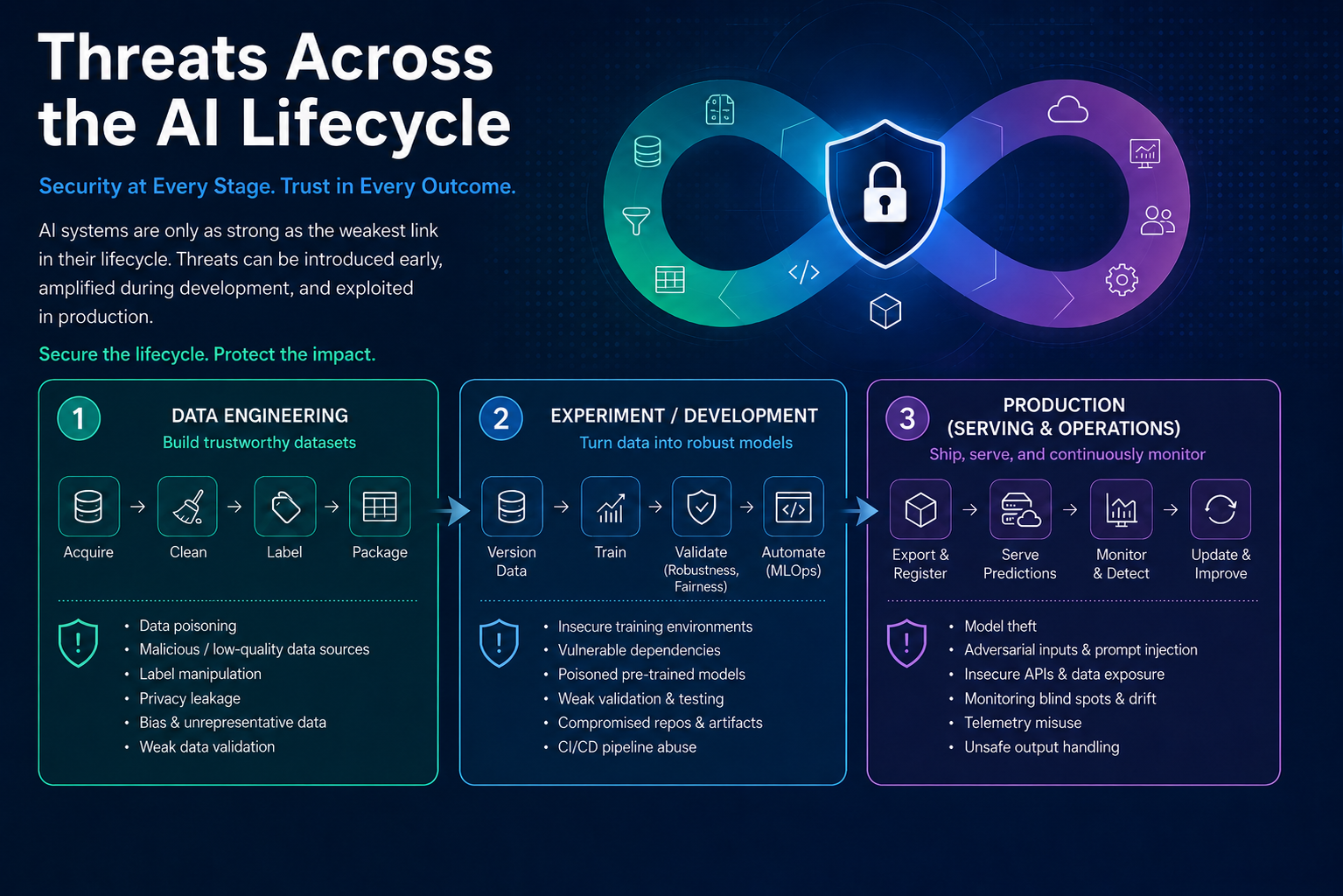
This article introduces the three major stages of the AI lifecycle and explains why each stage creates its own security risks. The goal is not only to list AI threats, but to show how they connect. A weak dataset can produce a weak model. A weak model can create unsafe decisions. A weak deployment can expose users, businesses, and society to real harm.
The Three Major Stages in AI Lifecycle
For this series, the AI lifecycle is divided into three major stages:
01
Data Engineering
This stage focuses on building trustworthy datasets. It includes data acquisition, cleaning, labelling, validation, transformation, and packaging data for training.
Data poisoning and label manipulation
Biased, incomplete, or weakly validated datasets
Privacy leakage and poor data provenance
02
Experiment & Development
This stage turns data into models through versioning, training, evaluation, robustness testing, fairness checks, experiment tracking, and MLOps automation.
Insecure training environments
Vulnerable dependencies or poisoned pre-trained models
Compromised repositories and CI/CD pipeline abuse
03
Production, Serving & Operations
This stage ships and runs models in real-world environments, including export, registry management, API serving, prediction handling, monitoring, logging, and drift detection.
Prompt injection and adversarial inputs
Model theft, insecure APIs, and sensitive data exposure
Unsafe outputs, telemetry misuse, and monitoring blind spots
What Comes Next in This Series
Visual summary of threats across the AI lifecycle.
This introductory article sets the foundation for understanding why AI security cannot be treated as only an application security problem or only a model security problem. Threats can appear at every point where data, code, models, infrastructure, and users interact. A weakness introduced early in the lifecycle can silently influence later stages, making it difficult to detect once the model reaches production.
AI security is not a single checkpoint. Threats can emerge across the entire lifecycle, from data engineering and model development to production serving and continuous monitoring.
Upcoming deep dives
Data Engineering How compromised data pipelines teach models the wrong behavior.
Experiment & Development How automation, dependencies, and validation gaps introduce risk.
Production Operations How exposed AI services face real users, attackers, drift, and unsafe outputs.
In the next three articles, I will examine the AI lifecycle stage by stage.
The second article will focus on the Data Engineering stage. This is where raw data is acquired, cleaned, labelled, analysed, and prepared for training. I will discuss threats such as data poisoning, malicious or low-quality data sources, label manipulation, privacy leakage, biased datasets, and weak data validation. The key idea is simple: if the data pipeline is compromised, the model may learn the wrong behaviour before training even begins.
The third article will cover the Experiment and Development stage. This is where datasets are versioned, models are trained, validation is performed, and MLOps workflows automate experimentation. I will look at risks such as insecure model training environments, vulnerable dependencies, weak experiment tracking, model validation gaps, poisoned pre-trained models, compromised repositories, and CI/CD pipeline abuse.
This stage is especially important because many security failures are introduced through automation, reproducibility gaps, or insufficient testing before deployment.
The fourth article will examine the Production, Serving, and Operations stage. This is where models are exported, registered, served to users, monitored, and updated over time. I will discuss threats such as model theft, prompt injection, adversarial inputs, insecure APIs, sensitive data exposure, monitoring blind spots, model drift, telemetry misuse, and unsafe output handling. Production is where AI systems become exposed to real users, real attackers, and real operational pressure.
Across the series, the goal is not only to list threats, but to show how they connect across the lifecycle. AI security requires a lifecycle view because data problems become model problems, model problems become deployment problems, and deployment problems become business and safety risks. A secure AI system must therefore be designed, tested, monitored, and governed from the beginning, not patched only after it reaches production.
 GenShield AI